

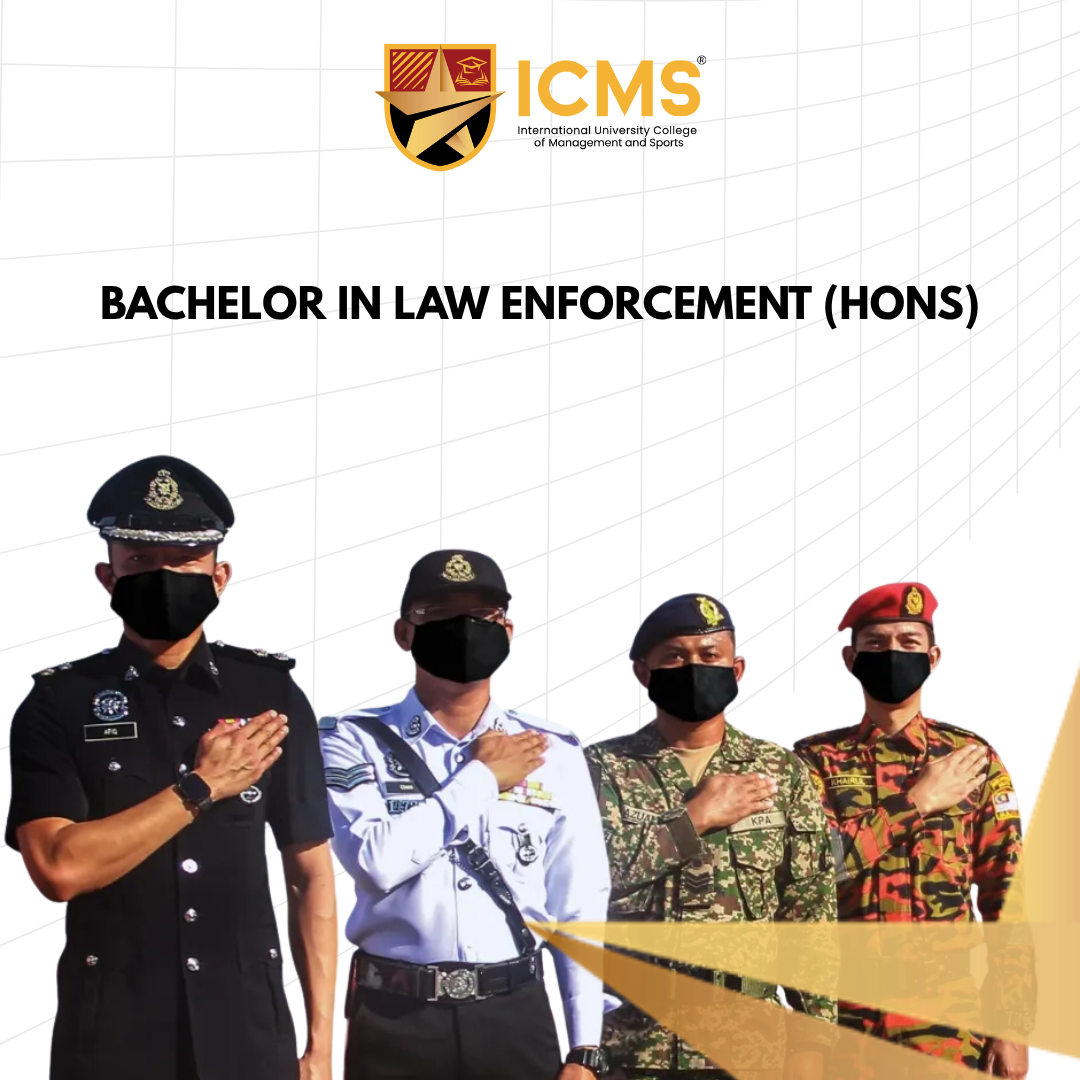
The Bachelor in Law Enforcement (Honours) programme offers a comprehensive and interdisciplinary curriculum that addresses the complex and evolving landscape of governance, security, and public accountability at both national and transnational levels. Designed to provide students with a solid academic grounding in legal studies, criminology, public administration, and investigative sciences, the programme also emphasizes the cultivation of ethical judgment and professional competence necessary for effective law enforcement. Through an integrated pedagogical approach that combines theoretical instruction with experiential learning including simulations, field training, and case-based analysis, students critically engage with legal frameworks, institutional practices, and behavioral dynamics central to the enforcement domain. Key subject areas such as criminal and administrative law, forensic psychology, intelligence operations, and community policing underscore the programmes commitment to intellectual rigour and applied relevance. Graduates are prepared to assume impactful roles in various sectors, including policing, customs, anti-corruption, corporate compliance, and regulatory bodies, and are equally equipped to pursue advanced studies or careers in international organizations and NGOs dedicated to justice, security, and human rights.
Study Method
Intakes
Duration
Study Mode
Teaching and Learning of Bachelor in law Enforcement with Honors
Lecture
Tutorial
Discussion & Presentation
Case Study
Group Works
Simulation
Mooting
Community Project
Industrial / Practical Training
Who should join?
Step into the future of security leadership. This programme empowers aspiring professionals with the insight, discipline, and strategic thinking to create meaningful change — locally and globally.
This programme is ideally designed for school leavers (STPM, A-Level, STAM, or equivalent) and diploma holders in policing, enforcement, security management, or legal studies who wish to advance their academic and professional competencies in law enforcement. It is also suitable for aspiring enforcement professionals seeking roles in public agencies such as the police, immigration, customs, and anti-corruption, as well as those pursuing careers in private sectors like corporate compliance, risk management, and security operations.
Distinctive Academic and Practical Features of the Programme:
The bachelor’s in law enforcement (Honours) at ICMS is distinguished by its integrative and practice-oriented academic design, which blends legal, criminological, psychological, and security-based disciplines into a cohesive learning experience. Emphasizing both conceptual depth and applied relevance, the programme incorporates investigative simulations, forensic exercises, and real-world field placements that connect classroom learning with operational enforcement settings. Its curriculum addresses contemporary issues such as cybercrime, transnational criminal networks, and regional security challenges within the Southeast Asian context, offering students a critical understanding of local and global enforcement dynamics. Delivered by a combination of academic scholars and experienced professionals, the programme fosters a learning environment that cultivates analytical thinking, ethical judgment, and professional adaptability. This pedagogical approach ensures that graduates are not only equipped with technical expertise but are also prepared to assume reflective, ethical, and leadership-oriented roles across a range of enforcement and regulatory domains
Study Focus Area:
Career Pathways
The programme equips graduates with versatile competencies applicable across a wide spectrum of enforcement-related professions in both the public and private sectors. Career opportunities include roles such as Police Officer, Customs Officer, Immigration Officer, Anti-Corruption Officer, Crime Scene Investigator, Intelligence Analyst, and Enforcement Officer in ministries and local government agencies.
In the private sector, graduates may pursue careers as Compliance Officers, Corporate Security Managers, Risk Analysts, or Fraud Investigators. Additionally, graduates are prepared for roles in NGOs and international organizations focusing on crime prevention, human rights, youth engagement, and community safety. The multidisciplinary training and ethical foundation embedded in the programme also support upward mobility into leadership and policymaking roles within enforcement and regulatory environments.
-
A pass in Sijil Tinggi Persekolahan Malaysia (STPM) with a minimum of Grade C (GP 2.00) in any TWO subjects*; OR
- A pass in Sijil Tinggi Agama Malaysia (STAM) with at least Grade Jayyid*; OR
-
Matriculation or Foundation with at least a Cumulative Grade Point Average (CGPA) of 2.00*; OR
-
A Diploma [Level 4, Malaysian Qualifications Framework (MQF)] with at least a CGPA of 2.00*; OR
-
A Diploma Kemahiran Malaysia (DKM)/ Diploma Vokasional Malaysia (DVM)*; OR
-
Other relevant equivalent qualifications recognised by the Malaysian Government.
English language requirement(s):
English Competency Requirement (International Student):
-
International English Language Testing System (IELTS) 5.0, Malaysian University English Test (MUET) Band 3.5 and other relevant English competency tests.
- Additional requirement for i-iv: A credit in ONE Science subject (Biology/Physics/Chemistry/General Science) at Sijil Pelajaran Malaysia (SPM) level or equivalent qualifications (Refer to the notes (*) below).
-
*A pass in Mathematics and English at SPM level or equivalent qualifications (English subject requirement does not apply to international students since they are required to meet certain scores of international English examination and privileged with certain exemptions),
-
Can be waived should any other higher qualifications contain Mathematics and English subjects with an equivalent/higher achievement.
-
Malaysian students using English as the medium of instruction in their previous study or with at least Band 2 in MUET or equivalent can be exempted from a pass in English requirement.
-
Those without a pass in Mathematics and/or English at SPM level or equivalent can be admitted but are required to attend special enhancement course(s). These special enhancement courses should be SPM equivalent, remedial in nature. Students must pass the Mathematics and English enhancement courses as a prerequisite to related core courses taught in English.
Supervision & Support
The Bachelor in Law Enforcement (Honours) programme at ICMS provides students with structured academic supervision and robust institutional support to ensure successful learning outcomes. Each student is assigned a dedicated academic advisor who offers personalized guidance throughout their studies, including support for coursework planning, research projects, and professional development. The final-year thesis or independent study is conducted under close supervision by qualified faculty members with expertise in law, criminology, and enforcement practice. Beyond academic mentoring, students benefit from a comprehensive support system that includes access to career services, counselling, English language enhancement programmes, and industry linkages for internships. The campus environment fosters a collaborative and inclusive culture, supported by workshops, seminars, and guest lectures from practitioners in the enforcement and legal sectors. This holistic approach ensures that students are well-prepared academically, professionally, and personally to meet the demands of the field.
Pathways & Career Outcomes
Academic Progression Opportunities
Graduates of the Bachelor in Law Enforcement (Honours) programme are well-positioned to pursue advanced studies at the postgraduate level, both locally and internationally. Academic progression may include master’s degrees in criminology, Criminal Justice, Law, Public Policy, Security Studies, Forensic Psychology, or International Relations. The research skills, analytical frameworks, and interdisciplinary exposure acquired during the programme also prepare students for entry into professional certification programmes or academic careers. ICMS’s strong academic foundation and industry-relevant curriculum ensure graduates meet the prerequisites of reputable postgraduate institutions and specialized training academies.
Career Pathways
The programme equips graduates with versatile competencies applicable across a wide spectrum of enforcement-related professions in both the public and private sectors. Career opportunities include roles such as Police Officer, Customs Officer, Immigration Officer, Anti-Corruption Officer, Crime Scene Investigator, Intelligence Analyst, and Enforcement Officer in ministries and local government agencies. In the private sector, graduates may pursue careers as Compliance Officers, Corporate Security Managers, Risk Analysts, or Fraud Investigators. Additionally, graduates are prepared for roles in NGOs and international organizations focusing on crime prevention, human rights, youth engagement, and community safety. The multidisciplinary training and ethical foundation embedded in the programme also support upward mobility into leadership and policymaking roles within enforcement and regulatory environments.

